
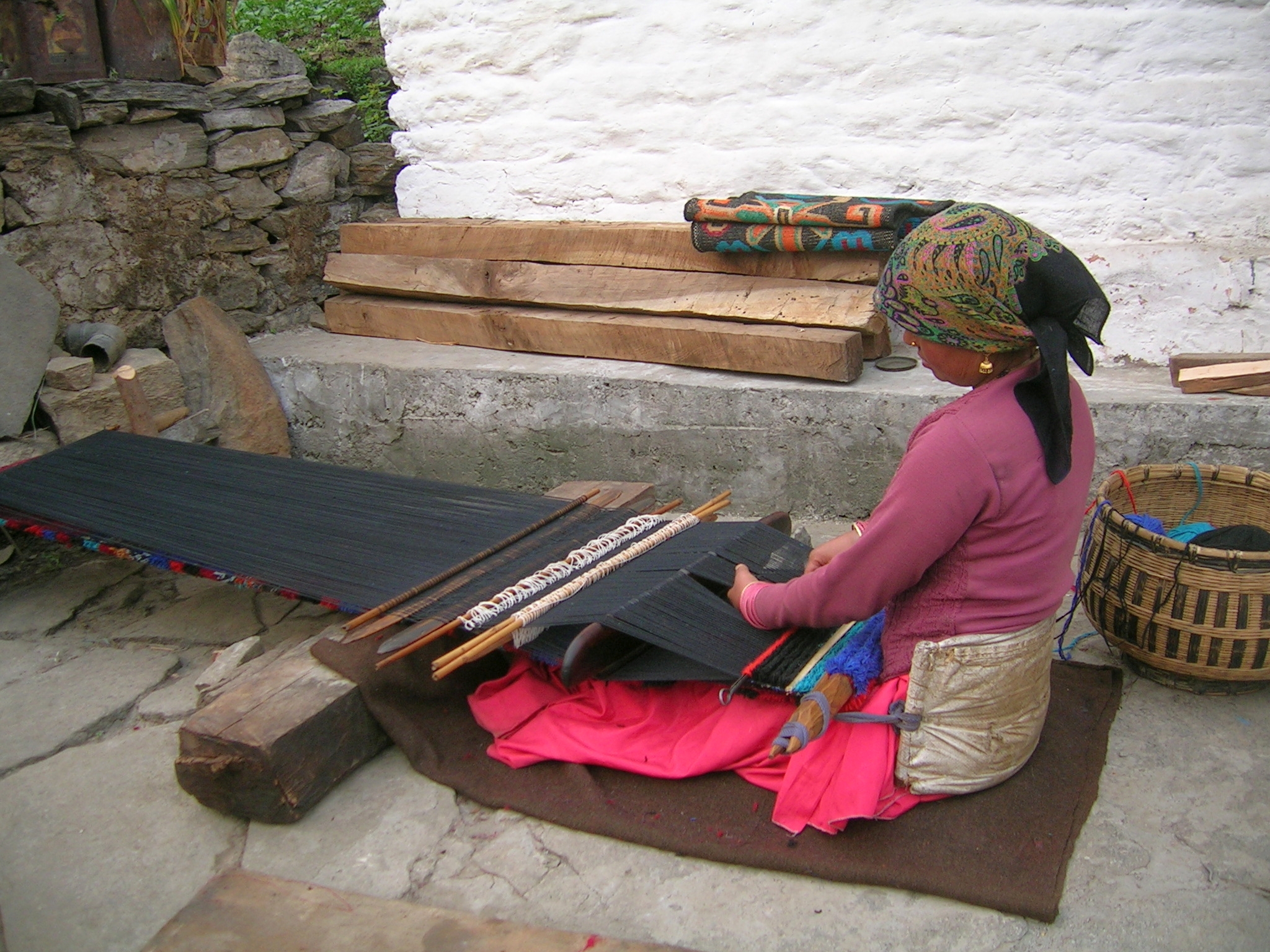
Kausani sits at 1,890 m on a ridge in Bageshwar district with a 300 km sweep of Himalayan peaks in front of it — Trisul, Nanda Devi, Panchchuli — and it is one of the few hill towns in Kumaon where you can watch a shawl being made, on a handloom, a few kilometres outside town.
Where the shawls come from
Kausani's best-known workshop is the Kausani Shawl Factory, about 3 km north of the town at Village Pinglakot. It is a working weaving shed rather than a showroom: local women weave on handlooms in front of visitors, and the shawls, stoles, blankets, jackets, caps and socks are sold from the same premises. Lonely Planet suggests calling ahead before you turn up.
Around it, shawls are sold in the shops along the Kausani–Almora road and in the bazaars at Almora and Bageshwar.
What the workshops make
- Shawls and stoles — the main product, in wool, wool-silk and pashmina grades.
- Thulma — the thick handwoven Himalayan blanket. Bedding rather than clothing, and much heavier than a shawl.
- Pankhi — the woven woollen wrap of the Bhotiya weaving tradition.
- Knitted goods — caps, socks, mittens, mufflers, sweaters.
- Jackets and waistcoats — wool over a cotton lining.
What it is made of
Sheep wool is the base. Hill wool is warm but coarse, so it is often blended with merino for softness. Above that:
- Pashmina (cashmere) — the fine undercoat of high-altitude goats, mostly bought in from Ladakh and hand-spun before weaving.
- Yak wool — nearly as fine as pashmina, dark brown, and usually left undyed.
- Himalayan nettle — bicchu ghaas, the stinging nettle of the Kumaon hills, retted and spun into a fibre with a linen-like handle.
The tradition behind the loom
Wool weaving in these hills belongs to the Bhotia community, whose economy was built on trans-Himalayan trade with Tibet. Wool was one of the goods they brought back over the passes and traded in markets such as Rishikesh and Kotdwar. That trade stopped in the early 1960s after the Indo-Chinese border conflict, and hand-weaving became an important source of income for the families who had lived by it.
Natural dyes
Some Kumaon workshops have gone back to plant-based colour, and the dyes are the plants of the hills: madder for reds, indigo for blues, tesu flowers for orange and yellow, harada and shellac for deeper browns and purples, with walnut, pomegranate, marigold and sappanwood in the mix. Naturally dyed wool tends to shift and soften with age rather than stay flat.
How to judge a shawl
- Hold it up to the light. A densely woven shawl shows very little daylight through it.
- Look at the selvedge, the finished edge. It should run straight and even, without puckering.
- Feel the weight. Hand-spun wool is lighter and softer than machine-spun at the same warmth.
- Check both faces. A printed shawl should be evenly printed on both sides.
- Read the label, not the sign. "Pashmina" describes a fibre. Pure pashmina is expensive and uncommon; many shawls sold as pashmina are wool or wool-silk blends.
- Smell it. Natural dyes carry a faint earthy smell; chemical dyes smell of very little.
What to pay
Expect a few hundred rupees for a small machine-made muffler and several thousand for a handwoven pure-wool or pashmina shawl. For scale: a 100 × 200 cm pure-wool shawl from the Kausani Shawl Factory was listed at ₹1,499, marked down from ₹1,900, while handwoven natural-dye woollen shawls from Kumaon weaver brands online ran from about ₹4,700 to ₹15,000 depending on fibre and size. Prices change — treat these as a sense of proportion, not a quote.
Buying well
- Buy from the workshop where you can. You see who made it, and more of the money stays near the loom.
- Ask what the fibre actually is, and what the blend is if it is blended.
- Ask for a fibre-content label on anything described as pashmina above a few thousand rupees.
- Cash and UPI both work in the small shops.
- Check opening hours and whether the workshop is taking visitors before you make the trip. Hill businesses close for the monsoon and for festivals.
Where to buy
Alongside the workshops, a handful of Kumaon and Uttarakhand weaver brands sell shawls and stoles online and ship within India. The Kumaon weaver collectives and natural-dye workshops in the Shop are the ones worth starting with. Every one of them is an independent seller: we introduce them and link out to their own shop, and take no payment for what they sell.
Sources & further reading
Compiled from the following public sources. Verify details with the source before relying on them for travel.
- Kausani — Wikipedia
- Kausani Shawl Factory — Lonely Planet
- Kausani Shawl Factory — online store
- Bhotia wool weaving — Impart
- Bhotiyas and Himalayan wool — Himalayan Weavers
- Natural dyes and products — Avani Kumaon
Lead photograph: Shyamal L. / Wikimedia Commons (CC BY-SA 3.0)
